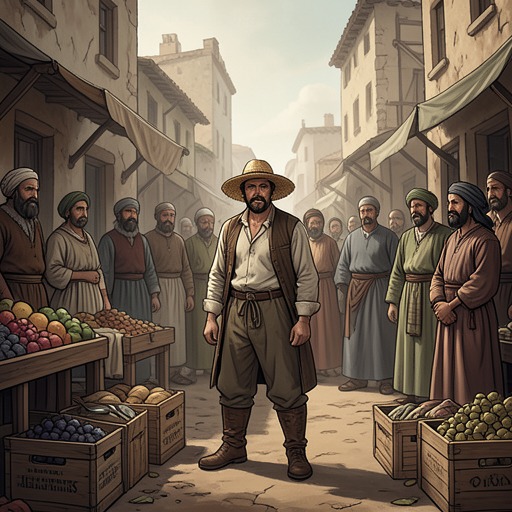
Grappa
Journey to the End of the NightLieutenant Grappa is the commander of the isolated colonial station at Topo, where his rule joins paperwork, taxation, and corporal punishment into a small-scale portrait of colonial authority. To Ferdinand Bardamu, he appears less as a capable administrator than as a man who avoids understanding the territory he governs, resents the demands made upon him, and looks toward eventual retirement in Toulouse.
Identity and Command
Grappa commands the Topo station and the surrounding territory. When Bardamu arrives, Grappa takes his papers, checks their authenticity, copies them into a new register, and invites him in for an aperitif. Bardamu is the first traveler to reach Topo in two years, a measure of the post’s isolation. Grappa’s relationship with his second-in-command, Sergeant Alcide, is strained: he warns Bardamu that Alcide can become too familiar if left unwatched.
That formal authority sits uneasily within a place where almost nothing arrives from the outside. The monthly steamer, the Papaoutah, is Topo’s rare connection with the colonial administration. Alcide prepares a sheaf of reports saying there is nothing to report, and Grappa signs them for dispatch to the Governor General. The ritual of administration continues even where its own paperwork declares the absence of events.
Administration and the Appearance of Order
Grappa’s military authority is visible in the station’s twelve-man militia, although the soldiers’ equipment exists largely in imagination. Alcide drills them through gestures with invisible packs and rifles. Grappa, meanwhile, has repeatedly requested proper uniforms and equipment. For two years he has waited for delivery, checking the Papaoutah’s arrivals with what Bardamu describes as skeptical optimism. The men remain without uniforms, and the long delay makes the station’s martial appearance a hollow performance.
The station’s other emblem of administration is its bamboo dock. Mollusks consume it so quickly that it must be rebuilt every month, and its repeated reconstruction is one of the burdens weighing on Grappa. The dock gives the colonial post a concrete, recurring maintenance problem, but its fragility also fits a wider pattern: official structures are constantly asserted and constantly undone by the conditions around them.
Grappa’s grasp of the territory is similarly limited. He relies on rudimentary maps and shows little interest in learning more about the lands under his charge. In his view, the jungle and its inhabitants need not be approached; he sees no useful result in making troublesome administrative incursions into remote communities. When his judicial duties are over, he prefers to turn toward the sea and look across the horizon from which he came and by which he hopes one day to leave.
Justice and Punishment
Grappa presides over a court in his hut, where complainants and witnesses gather to put forward disputes through an interpreter. Their accounts reach him in a loud, barely intelligible mixture, and he receives the proceedings from a creaking cane chair. The scene presents a formal hearing whose apparent order depends on Grappa’s interpretation, while the complaints themselves remain difficult for him to understand.
One case makes the character of his justice unmistakable. An elderly man has repeatedly come with a dispute concerning sheep. Grappa dismisses him as a nuisance and orders twenty strokes. The man does not appear to understand at first what is being done to him, and the militia carry out the sentence while the assembled public remains silent. When it is over, Grappa relights his cigar and affects detachment. Bardamu suggests that Grappa is not uniquely cruel so much as unwilling to think; the questions that come with judging people exasperate him.
Other hearings bring further punishments over disputes involving dowries, threats, broken promises, and uncertain parentage. Grappa complains that the local people’s quarrels leave him cold and that they should remain in the jungle rather than trouble him. Yet he also notices that the same people return to his court week after week. He interprets their repeated appearances as a taste for his justice, an explanation that lets him avoid asking what the proceedings mean to those who seek it.
Taxation and Colonial Rule
Grappa’s authority is not confined to the courtroom. The surrounding communities pay a small tax collected by force, and young men are recruited into the militia that wields the clubs. The same coercion structures the administration’s relationship with its subjects both as taxpayers and as defendants. Grappa’s justice is presented not as an impartial system but as one more instrument through which the post exercises power.
Bardamu contrasts Grappa’s system with Alcide’s modest trade in tobacco, brandy, and cotton goods. Alcide extends credit against the militiamen’s pay, and the soldiers come to spend their wages in advance on tobacco rather than trying to collect them. The contrast is not between exploitation and its absence: Alcide also controls access to scarce goods and uses physical reprimands. But Bardamu calls Alcide’s arrangement a more modern and hypocritical system, in which each soldier becomes a customer. Grappa’s direct extraction of tribute and Alcide’s commercial entanglement thus appear as different forms of colonial power, one openly punitive, the other mediated through trade and dependence.
Isolation and Narrative Significance
Grappa’s hostility toward the local population coexists with a private sense of exile. He spends his leave in Toulouse and plans to settle there after retiring in six years. His attention is fixed on the route back across the sea, even as his command requires him to administer a territory he does not wish to know. The distant prospect of departure becomes a substitute for engagement with the present.
Through Grappa, Topo’s colonial administration appears both forceful and absurd: it maintains registers and a court, awaits uniforms that never arrive, rebuilds a dock repeatedly, and taxes people whose circumstances its commander declines to understand. Grappa is a local authority, but his rule also makes visible a broader machinery in which coercion and bureaucracy reinforce one another. His preferred view is not of the communities he governs but of the horizon leading away from them.